
Texas Licensed Structural Repair Specialists
(469) 945-0151
Engineering SystemsPublished: February 16, 2025•11 min read•2,210 Words

Pressed Concrete Piers vs. Steel Piers in Texas: Which Is Best for Your Soil?

A detailed geotechnical comparison of skin friction concrete cylinders versus end-bearing concentric steel push piers, depth to refusal, and engineering recommendations across Texas.

Geotechnical Structural Review Board
Senior Engineering Advisory • PE Certified Texas Structural & Soil Consultants
Verified Structural Accuracy
Pressed Concrete Piers vs. Steel Piers in Texas: Which Is Best for Your Soil?
Executive Summary & Key Takeaways
  • Pressed concrete piers rely primarily on skin friction against surrounding clay, typically reaching depths of 10 to 18 feet.
  • Steel push piers are end-bearing systems driven by high-pressure hydraulics to true refusal on solid limestone or dense shale, reaching 25 to 65+ feet.
  • In deep active clay areas (like Houston or North Texas), concrete piers can experience minor secondary movement if clay beneath the pier dries and contracts.
  • Steel piers have a narrower profile (2.875 to 3.5 inches), allowing them to slice through dense clay without premature friction lock.
  • While steel piers cost more per unit ($650-$1,200 vs $350-$600 for concrete), they offer unmatched permanence in deep-soil environments.

1. The Underpinning Dilemma in Texas: Why Shallow Fixes Fail

When a home's foundation experiences differential settlement in Texas, surface-level solutions such as mudjacking, cosmetic mortar repointing, or shallow concrete pads will not provide lasting stability. Because the top 10 feet of soil is continuously expanding and contracting with the weather, any repair that relies on this active zone will move again.

Permanent stabilization requires deep structural underpinning. Piers are driven deep beneath the concrete grade beam to transfer structural loads to stable, immovable strata. Whether performing engineered slab foundation repair or addressing foundation beam cracks through structural foundation crack repair, selecting the appropriate pier system is the defining engineering decision.

Property owners facing a foundation repair project will encounter two dominant systems: pressed concrete pilings and concentric steel push piers. Selecting the right system depends on local geology, bedrock depth, and structural load requirements.

2. Pressed Concrete Pilings: Design and Mechanics

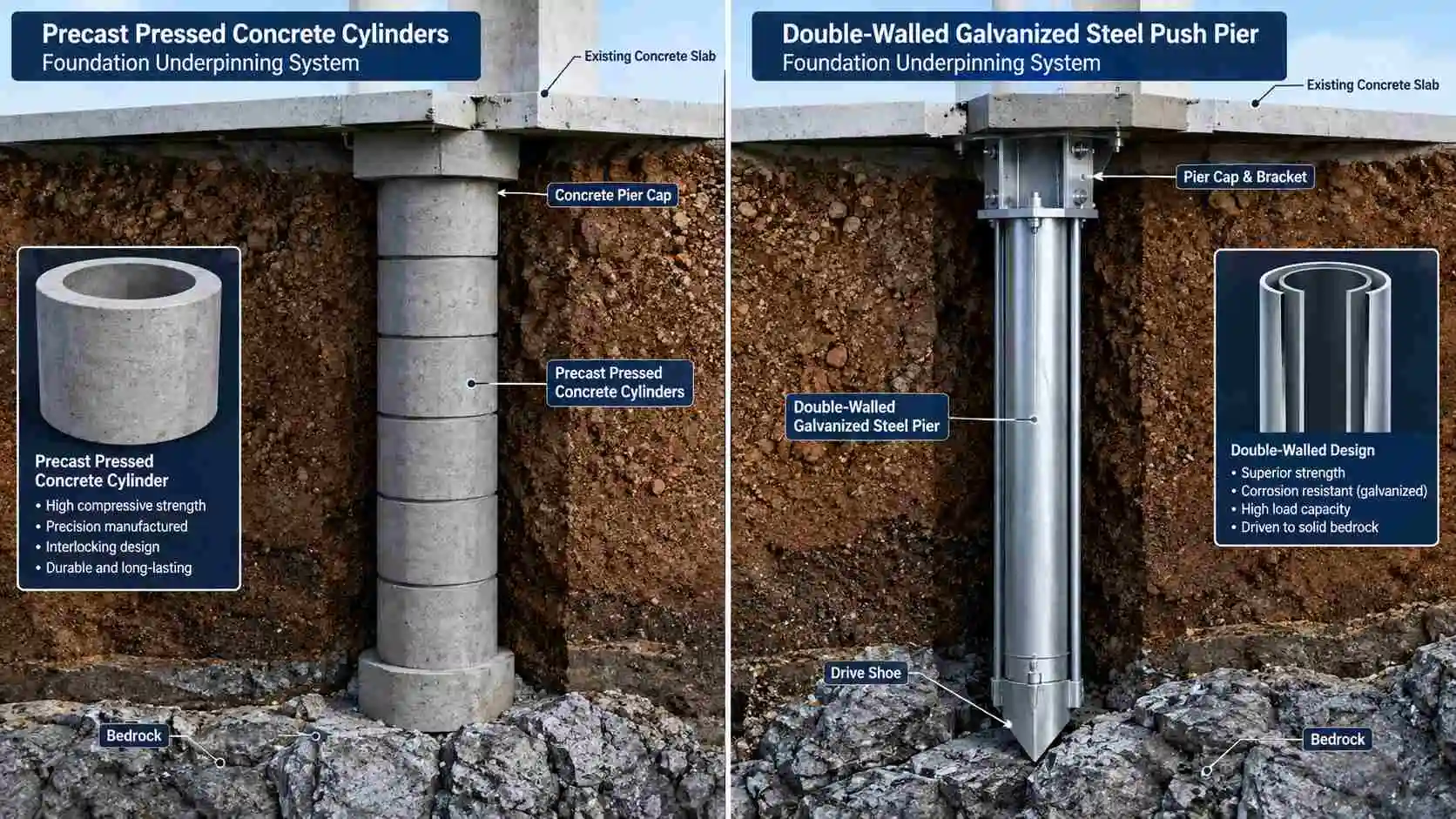
Pressed concrete pilings are the most widely installed foundation underpinning system in Texas residential repair. They consist of precast concrete cylinders, typically 6 inches in diameter and 12 inches in height, with a compressive strength of 5,000 to 6,000 PSI.

Crews dig an access pit (approximately 3x3 feet) beneath the exterior grade beam. A hydraulic ram is braced between the underside of the beam and the first concrete cylinder. Using the home's dead weight as resistance, the ram presses the cylinder into the ground. A second cylinder is placed on top, aligned with an internal steel cable or interlocking rebar insert, and pressed down. This process continues until the hydraulic pressure meets refusal.

  • Economical installation cost, making it accessible for budget-conscious homeowners.
  • High compressive strength capable of supporting typical single-story residential loads.
  • Installed quickly, often completing an entire 15-pier job in 1 to 2 days.
  • Relies on the weight of the home to drive the cylinders downward.

3. Concentric Steel Piers: Design and Engineering

Steel push piers represent the gold standard in deep structural foundation underpinning. They are fabricated from heavy-gauge structural steel tubing, typically 2.875 to 3.5 inches in outside diameter, coated with corrosion-inhibiting powder coating or hot-dip galvanization.

Unlike concrete cylinders with a broad 6-inch surface area, steel piers have a slim profile. They easily slice through dense clay, root systems, and intermediate soil layers without stalling prematurely due to surface friction. Steel piers are pushed until the driving ram reaches pressures between 8,000 and 10,000 PSI upon contacting solid limestone bedrock or load-bearing shale.

  • Penetrates deep into load-bearing strata, reaching depths of 25 to 65+ feet.
  • Minimal site disturbance with smaller excavation pits.
  • Provides true end-bearing support on solid bedrock, completely independent of active soil layers.
  • Endorsed by geotechnical and structural engineers for heavy two-story and commercial structures.

4. Skin Friction vs. End-Bearing Resistance

The critical engineering difference between concrete cylinders and steel piers lies in how they achieve load capacity.

Pressed concrete cylinders are predominantly skin friction piers. As the 6-inch cylinders are pressed into dense clay, the soil pushes tightly against the sides of the column. Eventually, the friction along the cylinder walls equals the driving force of the hydraulic ram, stopping further penetration. In many Texas areas, this friction refusal occurs at 10 to 18 feet. If a prolonged multi-year drought dries out the clay down to 14 feet, that surrounding friction can decrease, allowing secondary settling.

Steel piers, by contrast, are pure end-bearing piers. Their slim diameter minimizes skin friction, ensuring that virtually all driving force is directed to the tip until it embeds firmly into unyielding bedrock. Once anchored on bedrock, no amount of drought, moisture fluctuation, or topsoil contraction can affect the pier's elevation.

Direct Texas Engineering Support

Notice These Symptoms on Your Texas Property?

Speak with our senior foundation diagnostics team today for a free on-site elevation assessment.

Call (469) 945-0151

5. Cable-Lock Systems vs. Unlocked Concrete Cylinders

A major technological advancement in concrete pilings is the Cable-Lock alignment system. Early generation concrete piers were simply stacked cylinders pushed one by one into the earth. When encountering a subterranean rock shelf or dense clay pocket, individual cylinders could deflect sideways, breaking the vertical column and losing load capacity.

Modern high-grade installations run a high-tensile 3/8-inch galvanized steel aircraft cable directly through the center of every hollow cylinder. Once the column reaches refusal, the cable is tensioned and locked with a specialized steel cap. This locks the entire 15-foot column into a rigid, monolithic post that resists lateral soil shearing forces.

6. Depth of Refusal and Soil Layer Penetration

The concept of 'refusal' is critical. Refusal is the depth at which the hydraulic ram can push the pier no deeper without lifting the house off its footing.

Because concrete cylinders have a broad 6-inch footprint, they often achieve friction refusal in dense clay strata before reaching solid rock. In contrast, concentric steel piers slice through intermediate clay layers, only stopping when they strike genuine rock or dense shale.

7. Soil Chemistry, Sulfates, and Pier Longevity Across Texas

Homeowners frequently ask if steel piers will rust underground, or if concrete cylinders will dissolve over time. The answer lies in local soil geochemistry.

In West Texas and portions of the Permian Basin, soils contain elevated concentrations of water-soluble sulfates (sodium sulfate and magnesium sulfate). When sulfate ions penetrate unreinforced or porous concrete, they react chemically with hydrated calcium aluminate to form expansive ettringite crystals. Over decades, this internal crystalline pressure can cause surface spalling and gradual deterioration of concrete cylinders. Homeowners in arid regions such as Abilene and the Big Country or Odessa and the Permian Basin must account for local soil chemistry when choosing between concrete cylinders and galvanized steel.

Steel push piers, on the other hand, are manufactured to ASTM A123 hot-dip galvanizing standards, providing an impervious metallurgical zinc alloy barrier. Below the topsoil layer, the subsurface environment lacks sufficient free oxygen to sustain rapid electrochemical corrosion (rusting). As a result, galvanized steel push piers deliver an engineering service life exceeding 100 to 150 years in diverse Texas soil types.

8. Structural Load Calculations and Engineering Safety Factors

Structural engineers calculate foundation underpinning requirements using a strict safety factor methodology: Ultimate Bearing Capacity divided by Design Working Load must equal at least 2.0 to 2.5.

A typical pressed concrete cylinder column has an ultimate compressive load limit of roughly 6,000 to 8,000 pounds before friction failure occurs. While adequate for single-story wood frame homes with light asphalt shingles, heavy two-story brick residences generate perimeter dead loads that exceed this capacity during extreme drought soil contraction.

Concentric steel push piers, by contrast, are rated for ultimate compressive loads exceeding 25,000 to 45,000 pounds per pier bracket. Because they transfer load directly onto immovable bedrock, they provide an unmatched factor of safety, ensuring the foundation cannot settle even if the entire surrounding soil column loses moisture.

  • Single-story homes with vinyl siding: Standard working load of 1,200 to 1,800 lbs per linear foot of grade beam.
  • Two-story homes with exterior brick veneer: Working load of 2,800 to 4,200 lbs per linear foot.
  • Heavy stone masonry fireplaces and chimneys: Point loads frequently exceeding 8,000 to 15,000 lbs.

9. Synchronized Multi-Manifold Hydraulic Lifting Physics

A major misconception is that contractors simply jack up one corner of a home at a time. Doing so would place immense torsional shear stress on the concrete grade beam, immediately cracking sheetrock, popping interior crown molding, and breaking window panes.

Professional installation utilizes a unified hydraulic manifold system. Multiple hydraulic cylinders located at every pier position are connected in parallel to a centralized pump. When the operator pressurizes the system, the entire settled grade beam rises simultaneously in minute 1/8-inch increments, following proven precision house leveling protocols.

Digital altimeter sensors and laser levels monitor interior elevation in real time, stopping the lift precisely when the floor plane returns to true level design tolerances.

10. Head-to-Head Comparison Matrix

Compare both systems side-by-side across crucial performance criteria. For budget planning across individual pier types, review our complete Texas foundation repair cost guide.

Comprehensive Comparison: Pressed Concrete vs. Steel Piers
Performance MetricPressed Concrete PilingsConcentric Steel Push Piers
Support MechanismFriction with surrounding clay + partial end bearing100% End-bearing on solid limestone or bedrock
Average Depth Reached10 to 18 Feet25 to 65+ Feet
Cost Per Pier Installed$350 to $600$650 to $1,200
Risk of Secondary SettlingLow to Moderate in deep drought cyclesZero (Completely independent of active clay)
Installation FootprintRequires 3x3 ft excavation holeRequires smaller 2x2 ft excavation hole
Load CapacityApproximately 6,000 to 8,000 lbs per pierExceeds 20,000 to 30,000 lbs per pier
Best Texas ApplicationSingle-story homes with moderate clay depthsTwo-story homes, deep clay soils, commercial buildings

11. When Structural Engineers Mandate Steel Piers

While concrete cylinders remain a popular, budget-friendly option for many single-story residential properties, independent structural engineers across Texas frequently specify steel piers under specific conditions:

  • Two-story residential structures and heavy masonry or stone exteriors where structural dead weight requires high load capacity.
  • Properties in the Gulf Coast region (Houston, Beaumont) where stable load-bearing strata lie 35 to 60+ feet below surface alluvium.
  • Homes built on steep slopes or ravines where lateral soil creep could deflect concrete cylinder columns.
  • Commercial properties, retail centers, and multi-family complexes requiring strict structural deflection tolerances.

12. Step-by-Step Installation Workflow: What to Expect on Site

Understanding the day-by-day sequence of a professional pier installation ensures homeowners know exactly what will take place around their property:

  1. 1Site Preparation and Excavation (Day 1): Crews carefully dig 3x3 foot access pits along the designated perimeter grade beam. Tarps are laid over lawns to protect landscaping and turf.
  2. 2Bracket Attachment & Driving (Day 1 - Day 2): Heavy-gauge steel brackets are bolted to the exposed concrete beam. Hydraulic rams drive the pier sections downward sequentially while monitoring hydraulic pressure gauges.
  3. 3Hydraulic Elevation Restoration (Day 2): Synchronized hydraulic jacks lift the settled sections of the foundation back into level alignment, as verified by interior digital manometer readings.
  4. 4Locking & Shimming (Day 2 - Day 3): Heavy-duty steel shims are placed between the pier bracket and the foundation beam to lock the elevation permanently in place.
  5. 5Backfill, Compaction & Site Cleanup (Day 3): Soil is backfilled into excavation pits, tamped in lifts, and turf is replanted. All walkways and driveways are washed down clean.

13. Frequently Asked Questions: Concrete vs. Steel Piers

Answers to frequent homeowner questions about pier selection in Texas.

Frequently Asked Questions

Expert Answers on This Topic

Frequently Asked Questions

Clear, straightforward answers about Texas foundation repair, soil conditions, and engineering procedures.

Yes, this hybrid approach is common. Structural engineers often specify heavy-duty steel piers along the critically loaded, two-story section or settling exterior corner, while using pressed concrete piers along the lighter single-story garage or patio perimeter to optimize project costs.
Continue Reading

Related Engineering Guides

Immediate Texas Dispatch Available

Stop Foundation Damage Before Cracks Spread Further

Texas expansive clay soils don't improve on their own. Get a certified multi-point elevation survey and clear repair roadmap today with zero high-pressure sales.

100% Free Elevation Surveys
Transferable Lifetime Warranties
Licensed Structural Specialists
Free Texas Inspection
(469) 945-0151
Call Now