
Texas Licensed Structural Repair Specialists
(469) 945-0151
Soil MechanicsPublished: January 14, 2025•11 min read•2,150 Words

Why Texas Expansive Clay Soil Destroys Foundations: Geotechnical Soil Mechanics and Protection Strategies

A comprehensive geotechnical examination of Montmorillonite clay, the shrink-swell cycle, active soil zone depths, and how Texas property owners can prevent catastrophic structural settlement.

Geotechnical Structural Review Board
Senior Engineering Advisory • PE Certified Texas Structural & Soil Consultants
Verified Structural Accuracy
Why Texas Expansive Clay Soil Destroys Foundations: Geotechnical Soil Mechanics and Protection Strategies
Executive Summary & Key Takeaways
  • Texas expansive clay soils contain Montmorillonite and smectite minerals that expand up to 30% when saturated and shrink severely during dry spells.
  • The active soil zone across Texas extends between 7 and 15 feet deep, far deeper than standard residential slab footings.
  • Differential settlement (uneven movement between perimeter beams and the slab interior) causes 90% of architectural and structural cracks.
  • Mature shade trees can extract 150 to 200 gallons of sub-slab water daily, causing localized perimeter drop.
  • A scientific perimeter moisture protocol using soaker hoses or automated drip irrigation can stabilize seasonal movement before costly underpinning is required.

1. The Geological Reality of Texas Soils: Why Foundations Move

Texas has one of the highest rates of residential and commercial foundation repairs in the United States. To understand why foundations crack, twist, and sink across the state, property owners must understand the ground underneath their footing. Millions of years ago, vast shallow inland seas covered large portions of Texas, depositing rich layers of organic marine sediments and volcanic ash.

As these ancient sea beds dried, they transformed into dense sedimentary clays known as smectites and montmorillonites. Today, formations such as the Eagle Ford Shale, Taylor Marl, and Navarro Group run diagonally across Texas, creating an environment where soil refuses to remain dimensionally stable.

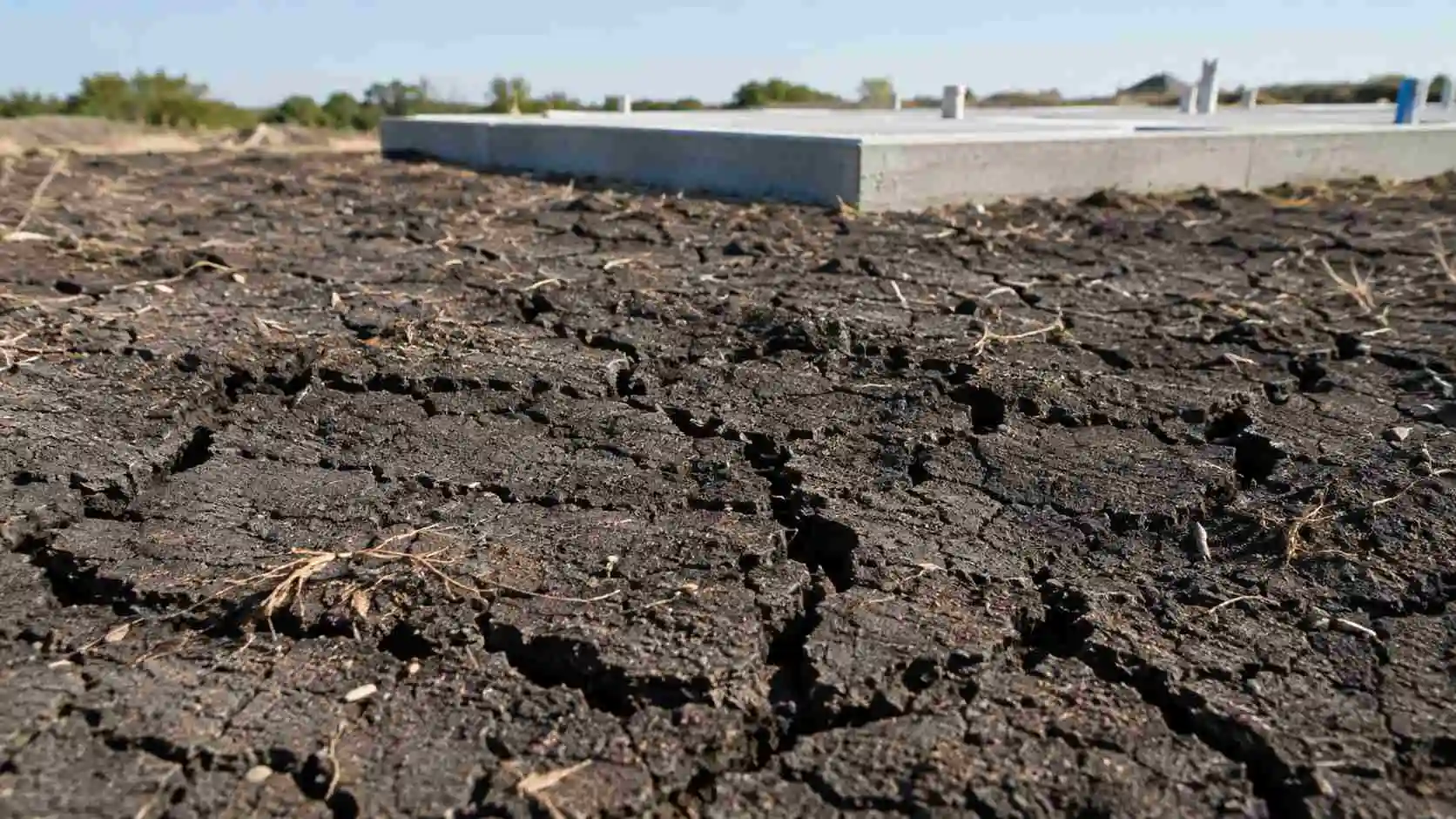
Unlike stable gravel, bedrock, or coarse sand found in other geographic regions, Texas clay behaves like a subterranean sponge. When moisture arrives during rainy seasons, the soil swells with massive upward hydraulic pressure. During prolonged Texas summer heatwaves, that same soil loses its moisture, contracts, fissures, and drops away from beneath reinforced concrete foundations.

Geotechnical Metric: The Plasticity Index (PI)

Geotechnical engineers evaluate soil instability using the Plasticity Index (PI). Soil with a PI above 25 is considered moderately expansive. Large swaths of Texas routinely register Plasticity Index values between 45 and 70, placing them in the extreme swelling potential category.

2. Mineralogy and the Shrink-Swell Mechanism

At a microscopic level, clay particles are structured in crystalline sheets. Montmorillonite clays are characterized by a 2:1 layer structure, consisting of two tetrahedral silica sheets sandwiching an octahedral alumina sheet. The bonding between these layers is exceptionally weak, allowing water molecules to slide freely between the sheets.

As water penetrates the lattice, each crystal expands. Multiplied across billions of soil particles beneath a house footprint, this microscopic expansion produces macro-level volumetric increases of 20% to 35%. The resulting swelling pressure can exceed 8,000 to 12,000 pounds per square foot, which easily overcomes the dead load weight of a single-family residential home.

Conversely, when moisture evaporates during drought conditions, the lattice collapses. Wide gaps and fissure cracks form in the yard, often 2 to 4 inches wide and penetrating several feet deep. When the soil contracts, it loses physical contact with the foundation grade beam. Unsupported sections of concrete slab are left bridging over empty cavities, until gravity and structural dead weight cause the slab to crack and sag.

  • Microscopic water uptake forces individual crystalline layers apart.
  • Swelling pressures of up to 10,000+ PSF push upward against residential concrete slabs.
  • Severe summer droughts draw moisture out, leaving subsurface voids under the perimeter grade beams.
  • The cycle repeats annually, subjecting structural elements to continuous flexural fatigue.

3. Texas Regional Soil Analysis: Variations Across the State

While expansive clay is prevalent, Texas soil composition varies substantially by region. Understanding your local soil characteristics helps determine the exact foundation maintenance protocol and underpinning depth required. For instance, homeowners dealing with heavy Blackland Prairie clays rely on specialized North Texas foundation repair in Denton, whereas properties situated on caliche and sandy formations require targeted Lubbock foundation stabilization services.

The table below outlines the predominant soil profiles, average active zone depths, and primary failure modes observed across major Texas regions.

Geotechnical Soil Comparison Across Texas Regions
Texas RegionPredominant Soil CompositionPlasticity Index (PI)Active Zone DepthCommon Foundation Vulnerability
North Texas / DFW & Blackland PrairieHouston Black Clay, Eagle Ford Shale50 to 65 (Extreme)10 to 15 FeetSevere perimeter drop, corner shears, stuck interior doors
Central Texas / Austin & San AntonioTarrant & Austin Chalk Clays, Limestone Outcroppings35 to 55 (High)6 to 10 FeetDifferential upheaval over rock shelves, tile crack lines
Gulf Coast / Houston & BeaumontBeaumont Clay, Saturated Alluvial Silt40 to 60 (High)8 to 12 FeetSubsidence, center-slab deflection, high water table heave
West Texas & Permian BasinReeves & Reagan Caliche Clays, Arid Sandy Loam25 to 40 (Moderate)5 to 8 FeetWind erosion voids, rapid drought desiccation, sandy soil settling
Panhandle / Amarillo & LubbockPullman Clay Loam, High Plains Sediments30 to 45 (Moderate)6 to 9 FeetFreeze-thaw cycling, windward perimeter shrinkage

4. Differential Settlement vs. Uniform Soil Movement

A critical distinction in structural forensics is the difference between uniform movement and differential settlement. If an entire home rises or settles by two inches uniformly, the structure experiences minimal internal stress. Doors still swing correctly, and sheetrock remains intact because the building stays planar.

The true enemy of Texas foundations is differential movement. This occurs when one corner or edge of the foundation moves at a different rate or in an opposite direction than the remainder of the slab. For instance, the south-facing exterior wall exposed to direct Texas summer sun may dry out and drop 1.5 inches, while the shaded, moisture-rich north perimeter retains its elevation.

Concrete is exceptionally strong in compression but relatively weak in tension and flexure. When a slab experiences differential movement, tensile stresses build within the concrete matrix until they exceed the tensile capacity of the reinforced beams. The result is diagonal stair-step cracks through exterior masonry veneer, ceiling separation, warped door frames, and split interior drywall. Early diagnosis requires a professional foundation inspection and elevation survey to calculate exact deflection ratios.

  • Uniform settlement produces minimal architectural damage because elevation changes remain coplanar.
  • Differential settlement twists the foundation frame, generating severe diagonal shear forces.
  • Common triggers include uneven solar exposure, localized drainage ponding, broken sewer pipes, and thirsty trees.
  • According to ASCE Texas guidelines, deflection exceeding L/360 indicates unacceptable structural distress.
Direct Texas Engineering Support

Notice These Symptoms on Your Texas Property?

Speak with our senior foundation diagnostics team today for a free on-site elevation assessment.

Call (469) 945-0151

5. Vegetation, Trees, and Soil Desiccation

Large, majestic shade trees are prized across Texas properties, but their root systems are a primary contributor to localized foundation failure. A mature live oak, pecan tree, or cedar elm requires between 100 and 200 gallons of water per day during the summer.

Tree roots do not respect foundation boundaries. They aggressively spread into the moist, sheltered soil directly underneath residential grade beams. As the tree transpires water through its canopy, it extracts moisture directly from the clay beneath the footing. This phenomenon, known as root-induced soil desiccation, causes localized soil contraction right at the home corner.

Homeowners often notice that the corner of the house nearest a 30-foot oak tree sinks dramatically during July and August. Installing physical root barriers or providing supplemental localized irrigation is essential to protect structural integrity.

Root Barrier Rule of Thumb

If a large tree canopy extends within 15 to 20 feet of your foundation perimeter, consider installing a professional root barrier. Barriers are typically 36 to 48 inches deep, featuring impermeable chemical or physical barriers that deflect root growth away from your concrete grade beams.

6. Grading, Drainage, and Runoff Control

While keeping soil moist during drought is vital, allowing uncontrolled rainwater pooling around the slab is equally damaging. Saturated clay swells rapidly, creating localized upward heave that can crack slab interiors within days of heavy rainfall.

Proper foundation defense begins with surface grading. The International Residential Code (IRC) mandates that the ground slope away from the foundation at a minimum 5% grade for the first 10 feet. This translates to a 6-inch drop over 10 feet.

If your yard has a flat or reverse grade where rainwater pools against the foundation wall, engineered drainage solutions are necessary. Surface swales, catch basins, and deep French drains divert high-velocity runoff away from sensitive foundation perimeters before saturation occurs.

  • Ensure soil slopes 6 inches downward within the first 10 feet away from the grade beam.
  • Clean gutters regularly and install 5-foot downspout extensions to direct roof runoff away from walls.
  • Install French drains with perforated pipe and washed gravel along retaining walls and flat side yards.
  • Never allow sprinkler irrigation heads to spray directly against exterior brick or exposed concrete grade beams.

7. Scientific Foundation Watering: The Soaker Hose Protocol

To combat the severe shrink-swell cycle, Texas homeowners must maintain consistent soil moisture levels around the entire foundation perimeter throughout the year. The objective is not to soak the ground into mud, but to maintain the clay at a consistent moisture equilibrium.

The most effective DIY tool is an engineered soaker hose or automated drip irrigation system. However, placing and running the hose incorrectly can actually accelerate foundation damage.

Avoid Over-Watering

Over-watering can be just as hazardous as drought. Excess moisture creates localized clay upheaval and can saturate the sub-base, reducing load-bearing capacity. Consistency, not volume, is the key to soil stability.

  1. 1Hose Placement: Position the soaker hose 12 to 18 inches away from the foundation edge. Never place the hose directly against the concrete beam, as this can encourage water to run straight down the beam-soil interface.
  2. 2Burying the Line: Cover the hose with 2 to 3 inches of organic mulch. Mulch protects the rubber from UV degradation and prevents rapid evaporation in the Texas heat.
  3. 3Timing and Duration: Run the soaker hose 2 to 3 times per week during summer months, for 20 to 30 minutes per zone. In winter, reduce watering to once every two weeks if natural rainfall is scarce.
  4. 4The Screwdriver Test: Test soil moisture by pushing a standard 6-inch screwdriver into the soil near the house. If it penetrates smoothly with gentle hand pressure, moisture is optimal. If it requires heavy force or stops, the clay is too dry.

8. Engineered Underpinning Solutions When Watering Is Too Late

When differential settlement has already caused significant elevation drop, cosmetic patching and soaker hoses will not restore the slab to its level design plane. At this stage, professional structural underpinning is required. Depending on the home's structure, this involves specialized slab foundation repair or comprehensive pier and beam foundation repair to restore elevation tolerances.

Underpinning bypasses the unstable active clay layer entirely, transferring the structural weight of the building down to stable strata or solid limestone bedrock. Property owners can compare the mechanics of both underpinning options in our guide on pressed concrete pilings vs steel piers in Texas.

By installing piers beneath the perimeter grade beam and hydraulic jacks to level the structure, experienced contractors restore structural alignment and lock the foundation in place with heavy-duty steel shims.

9. Frequently Asked Questions: Texas Expansive Clay Soil

Below are detailed answers to the most common questions Texas property owners ask regarding expansive clay soil management, warning signs, and professional repairs.

Frequently Asked Questions

Expert Answers on This Topic

Frequently Asked Questions

Clear, straightforward answers about Texas foundation repair, soil conditions, and engineering procedures.

In most areas of Texas, the active clay zone extends between 7 and 15 feet deep. Beneath this active zone, moisture levels remain relatively constant year-round. Deep foundation underpinning systems must penetrate completely through this active zone to reach non-expanding strata or solid bedrock.
Continue Reading

Related Engineering Guides

Immediate Texas Dispatch Available

Stop Foundation Damage Before Cracks Spread Further

Texas expansive clay soils don't improve on their own. Get a certified multi-point elevation survey and clear repair roadmap today with zero high-pressure sales.

100% Free Elevation Surveys
Transferable Lifetime Warranties
Licensed Structural Specialists
Free Texas Inspection
(469) 945-0151
Call Now